River Valley Farm
In Cold BloodRiver Valley Farm is the western Kansas farmstead of Herbert William Clutter, a prominent farmer whose household and land are transformed by the murders of four members of the Clutter family. The property is more than the setting of a crime: its productive fields and intimate domestic spaces first express a carefully built family life, then become a crime scene, a place of investigation and grief, and finally an estate emptied and handed to new occupants.
Setting and the working farm
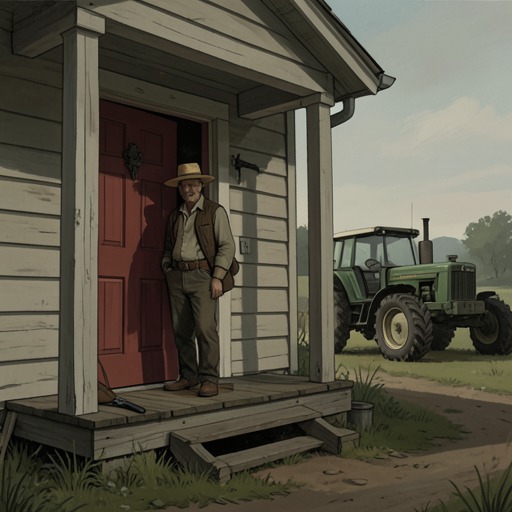
The farm lay about a mile and a half from the highway, approached by obscure roads that made accidental discovery unlikely. Its landscape included an orchard, a shallow stretch of river broken by sandy islands, a livestock corral, and three barns. One barn was a large Quonset hut filled with Westland sorghum; another stored a substantial hill of milo grain, valued in the account at one hundred thousand dollars. These details establish the scale and productivity of the operation without making the place a showpiece of wealth: the farm was a working enterprise, built from land, equipment, livestock, and the labor of employees.
Herbert William Clutter’s standing on the farm reflected a career that had developed alongside the agricultural life of the region. After marrying Bonnie Clutter, he moved with her from Rozel to Garden City in 1934 and began work as an assistant to the county agricultural agent. He was promoted within seven months and held the leading post from 1935 to 1939, during years of severe drought and economic hardship. His expertise in modern agricultural practices helped make him a respected figure in farming. By the time of the narrative’s opening, he was the farm’s master and a widely recognized citizen, with professional responsibilities extending beyond the property.
The farm’s routines made its prosperity tangible. On a clear November morning, Herbert William Clutter went outdoors wearing a fleece-lined cap and carrying an apple, accompanied by a mongrel dog. He walked toward the livestock corral beside one of the barns. The surrounding season, orchard, grain stores, and animals make this a lived-in agricultural landscape rather than a remote symbol of wealth. That morning, five pheasant hunters from Oklahoma appeared on the property. Although landowners customarily charged for hunting access, Herbert William Clutter allowed them to hunt without payment and continued home, unaware that he would not return to the day’s work.
Home, family, and local life
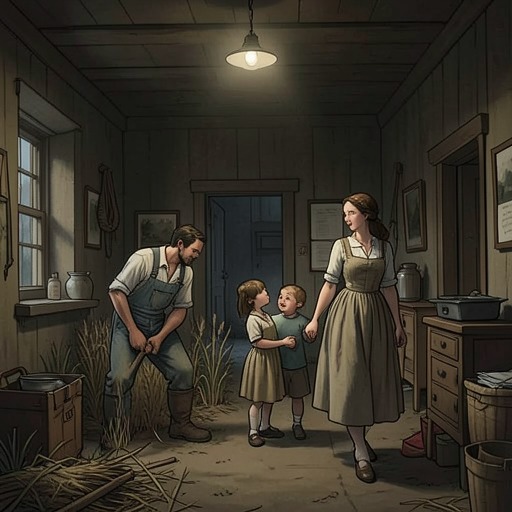
The main house stood within a property that was both secluded and socially connected. Herbert William Clutter’s local prominence reached Garden City and the wider agricultural community; his family home was a place where friends and neighbors were regularly received. The farm’s distance from the highway did not make it socially isolated. Its employees worked the land, visitors came to hunt, and Nancy Clutter’s schoolmate Nancy Ewalt was accustomed to arriving there on Sunday mornings so she could accompany the family to church in Garden City.
The arrangement became painfully visible after the murders. Nancy Ewalt arrived, rang and knocked at several of the house’s four entrances, and found no one to answer. She noticed both Chevrolet sedans in the garage, suggesting that the family was home, but did not enter. The ordinary practices of visiting and waiting at the door thus became part of the discovery’s surrounding chronology: the house looked occupied, but its silence concealed what had happened inside.
The family’s attachment to the farm was also carried by its smaller places and objects. Nancy’s horse, Babe, lived in the corral; she and Susan Kidwell had ridden her through the wheat fields and down to the river. Kenyon Clutter had rescued and repaired a couch in the playroom, and Nancy had covered it with a slipcover and arranged mottoed pillows. Herbert William Clutter’s orchard included fruit trees he had planted and tended. Such features gave the property a family history that could not be separated from its practical functions. After the deaths, the horse, the orchard, and the repaired couch remained as reminders of the people whose routines had shaped them.
The murders and the farm as crime scene
On the night the killers approached the property, Dick followed directions he had memorized, passing through Holcomb and turning onto the tree-lined private lane. He extinguished the headlights and proceeded by moonlight. In a later account, Perry described their arrival at the entrance and their view of the barns and house; a light appeared in the hired man’s house, about a hundred yards away, and then went out. The farm’s scale and layout mattered to the men as they tried to locate the house and assess the nearby employee’s residence. Their arrival turned a private road, familiar trees, and the distance between buildings into elements of a planned intrusion.
Four members of the Clutter family were murdered in the fourteen-room main house. The deaths were initially attributed in official documents to a person or persons unknown. The farm’s familiar rooms then acquired a second, terrible meaning: a basement furnace room, the playroom, and the upstairs bedrooms became sites authorities and investigators had to enter and examine. The account does not treat the house as an abstract crime-scene diagram. Its rooms retain the identity of the family who used them, even as the investigation attends to what happened there.
On November 16, Herbert William Clutter’s old hunting companions Andy Erhart, Dr. J. E. Dale, Carl Myers, and Everett Ogburn returned to the farm with mops, pails, brushes, rags, and detergents. They had once come there to hunt with their friend; now they volunteered to clean the house as an act of Christian duty. A highway patrolman waved them through the barricade at the entrance, and Alfred Stoecklein, the employee who lived on the property, admitted them. They began in the basement and proceeded through the house. Damaged furnishings and blood-soiled household materials had to be set aside for burning. The friends’ return marks the change from a welcoming home to a place that neighbors felt responsible for tending, even when its familiar hospitality was gone.
Investigation, absence, and mourning
The farm remained central to the investigation because its rooms held clues and its layout informed competing theories. While sorting Nancy Clutter’s clothes, her aunt Elaine Selsor found a gold wristwatch tucked into the toe of a shoe. Mrs. Helm, searching the house with an investigator, realized that Kenyon Clutter’s portable Zenith radio was missing. The discoveries prompted Alvin Dewey to reconsider robbery as a possible motive, though he resisted the conclusion that the family had been killed for a watch, a radio, and a small amount of money. The objects made the possibility of theft concrete, but they did not settle why the killers had acted.
Dewey repeatedly returned to the house. The heirs had removed a vanload of clothing and furniture, yet the rooms still seemed capable of receiving the family back: sheet music remained open on the parlor piano, Herbert William Clutter’s gray hat hung in the hall, and Kenyon Clutter’s spectacles rested on a shelf above his bed. The telephones were silent, their wires cut. From a rocking chair in the parlor, Dewey considered the evidence and his belief that the family had known the people who killed them. The setting’s quiet offered him space to think, but the familiar objects made each visit a renewed encounter with absence.
That absence spread beyond the house. In December, Paul Helm worked among the flower beds Bonnie Clutter had tended and remembered an earlier afternoon there with Kenyon Clutter. He worried that the property would be sold and that he would lose both his job and the place where he had long worked. Herbert William Clutter had once hoped that a Clutter and a Helm would always remain at the farm. By then, however, the hired man’s house was empty, Nancy Clutter’s horse waited in the field, windfall apples rotted beneath the trees, and the voices that had made the farm feel inhabited were gone. Bobby Rupp also returned to the property in grief. He found the lawn shabby, a gravel rake rusting in the driveway, and the ambulance tracks from the day the bodies were removed still visible in the grass. At the corral, he held Babe and rubbed his cheek against her neck, recalling the gesture Nancy Clutter had used with the mare.
Sale and change of ownership
The farm’s final public transformation came with the estate auction in March. Slightly more than five thousand people attended, far exceeding the turnout at a nearby farm auction earlier in the year. For many, it was the first opportunity to visit the Clutter property since the murders; others came to buy ranch equipment. The crowd moved down the lane past the orchard and the newly green lawn, where some visitors peered toward the unoccupied house. Tractors, trucks, tools, horses, and other equipment were sold, including Kenyon Clutter’s worn coyote wagon. The sale converted the practical contents of a working farm into separate purchases, while the visitors’ curiosity made the grounds a public spectacle.
Paul Helm, Vic Irsik, and Alfred Stoecklein served as stagehands, helping dispose of the possessions of the employer they had served for years. It was their last day at River Valley Farm. The property had been leased to an Oklahoma rancher, and strangers would henceforth live and work there. As the auction dismantled Herbert William Clutter’s material domain, Paul Helm compared the occasion to a second funeral. The final lot was the livestock corral’s horses, including Babe. Susan Kidwell, who loved the mare and remembered riding her with Nancy Clutter, wished she could give Babe a home but had nowhere to keep a horse. A farmer bought Babe for seventy-five dollars and led her away. In that departure, the farm’s larger transition became personal: the landscape remained, but the family’s relationships to its rooms, animals, work, and land could no longer be restored.